Physical Address
304 North Cardinal St.
Dorchester Center, MA 02124
Physical Address
304 North Cardinal St.
Dorchester Center, MA 02124
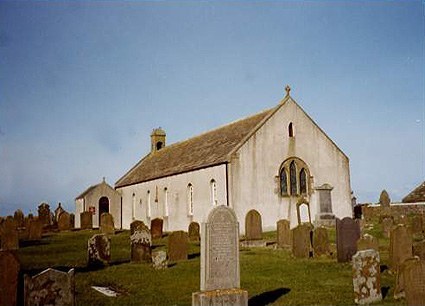
St Magnus Church, Birsay stands on the site of a much older church, in existence long before St Magnus Cathedral in Kirkwall. It is now accepted that St Magnus Church stands at least partly on the site of the original Christchurch built by Earl Thorfinn c. 1064. Thus the site has been in continuous use a place of worship for over 900 years, first as dyrligt musteri (a splendid minster) and then as the parish church. Joseph Anderson, who edited The Orkneyinga Saga, in 1873, assures us that this church was still referred to by the local people as ‘the Christ’s Kirk’.
The story is set in the eleventh century, Viking times told in the Sagas, and war spread throughout Britain. Norse and Danes held much of the land and were attacking to conquer the rest; their loss was William of Normandy’s gain in 1066. Orkney was a strategic centre, and the Earls of Orkney were powerful rulers of most of northern Scotland and the Western Isles. Too powerful for the King of Norway who invaded Orkney ca. 1098. The Earls, Erlend and Paul, were sent to their deaths, and their sons, Magnus Erlendson and Hakon Paulson, were taken to serve the King.
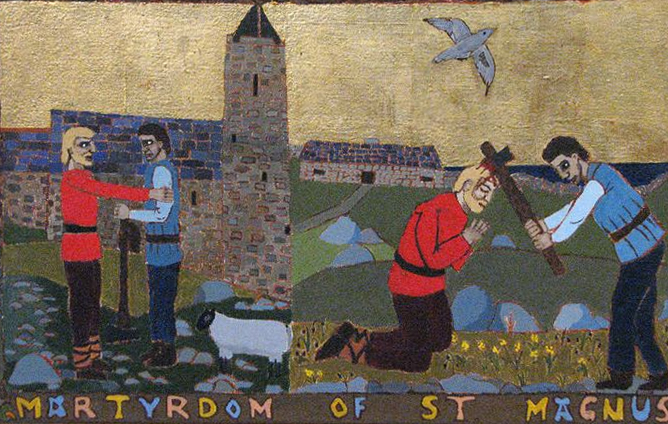
So it was that Magnus, then eighteen, found himself in a warship in the Strait of Menai preparing to attack Anglesey. He refused to fight preferring to sing psalms standing exposed, open to the danger of battle. After an enforced exile until the Norwegian king died, Magnus returned to Orkney to reclaim his share of his inheritance taken by Hakon. A joint rule lasted a few years, but disputes arose. Magnus arranged an Eastertide meeting for peaceful negotiation using the good offices of Bishop William “the Old”; Hakon had other means in mind, arriving with eight ship filled with warriors. Magnus made no attempt at defence or flight, but fell to prayer in the church on Egilsay. Hakon had him seized and killed.
Now the Bishop’s Cathedral – small by latter day standards – was in Birsay, most probably on the very site of the present Church. It was here that Magnus was buried, and here soon after that the miracles began, and pilgrims came for healing and absolution. Magnus was canonized in AD 1135, and a few years later his remains transferred to the new cathedral in Kirkwall.
After the murder of Magnus Erlendson in Egilsay, c. 1116, his body was brought to Thorfinn’s Christchurch for burial. Soon there were stories of ‘heavenly lights and a strange fragrance’ surrounding his grave. This was followed by many pilgrimages and stories of visions and miracles. Twenty years after his death, Magnus’ body was exhumed and his bones were placed in a shrine above the high altar in Christchurch. He was officially declared a saint, but times were changing. A large cathedral was built in Kirkwall to venerate the new saint and his bones were taken and interred there. The little church in Birsay was no longer the most important church in the Earldom.
The Church
Christchurch continued to serve the people of Birsay. In 1664 it was re-built as a cruciform church (shown in a 17th century drawing of the Earl’s Palace which is reproduced on p.83 in Exploring Scotland’s Heritage – Orkney and Shetland – Anna Ritchie, HMSO 1985). The church was again re-built in 1760 as a simple rectangular church, and in 1867 enlarged and restored. While the building was being restored in the 1980’s the stonework clearly showed the different phases of construction. Huge blocks of red sandstone formed the foundations at the south-east end of the church, an indication that this had been the site of a very important medieval church.
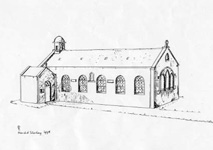
In 1875 a larger church was built in the parish at Twatt. However, the former Christchurch (now called St Magnus) continued to be a regular place of worship. In 1996 the Church of Scotland recognised that they could no longer support both the Twatt church and St Magnus Church. Thus, St Magnus Church was scheduled for closure. A Trust was formed and an historic step was taken. The Church of Scotland handed over the church to the Trust, who now have the responsibility of maintaining the church.
Architecture
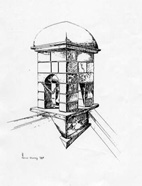
The rebuilt church incorporates some features of the earlier structures, including the 17th century belfry and a 13th century lancet window. In the base of this window is a broken lintel with the inscription ‘ S BELLUS’. The first part of the inscription ‘MON(S)’ is built into the window surround of the farm to the north of the church. This must have come from the residence of the 16th century bishops of Orkney, MONS BELLUS, which is known to have been nearby.
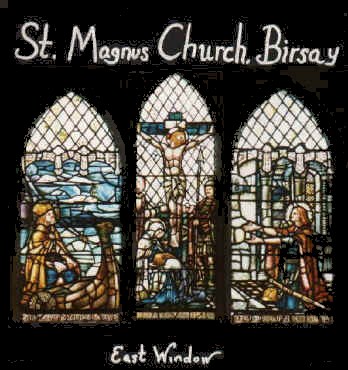
When the floor of the church was taken up during alterations in the early 1900s, two very old gravestones were found. One is now beside the pulpit. The inscriptions are now illegible, but there is a rough coat-of-arms and the date 1645. The other stone stands in the vestibule. The stained glass window installed shortly after 1900 was designed by Mrs. McPherson, wife of the minister, and made by Alex Strachan, whose brother designed and made one of the windows for St Magnus Cathedral, Kirkwall.
/